By Ozioma Onwumah · Content Marketer at Maildesk ·
Why Your Discovery Calls Aren’t Converting Into Clients
Your leads may not be the problem. 8 reasons discovery calls stall between “interested” and “yes” — and the follow-up system that closes the gap.

When you get discovery calls booked, there’s an excitement that comes with knowing the chances of that call turning into revenue have just increased.
But what happens when you wait 24 hours, then 48, and all that meets you is silence?
That excitement slowly trickles away. What should have been a potential client becomes another lead you have to chase — and you start wondering why your leads go cold after the first call, even when the conversation seemed to go well.
But what if your leads aren’t the problem?
What if the problem is what happens during and after your discovery calls?
It might sound strange, but if you’ve been wondering why your discovery calls aren’t converting and what you can do differently, keep reading.
What Does “Converting” Actually Mean?

Photo by Mina Rad on Unsplash
There are many ways to think about conversion, but let’s start by defining what conversion isn’t:
- It isn’t a booked call.
- It isn’t a good conversation.
- It isn’t a prospect saying, “I’ll think about it.” That’s not necessarily a rejection — but it isn’t a conversion either.
So, what is conversion?
At its simplest, conversion is the process of moving a prospect from interest to becoming a paying client. And that process happens in four stages:
Interest → Trust → Decision → Client
Interest
This is where it begins. A stranger becomes interested enough to interact with your brand — they discover you through a social media post, click a link, download a resource, or visit your website to learn more about what you do.
At this point, they’re curious. They want to understand who you are, what you offer, and whether you can help them solve the problem they’re facing.
But curiosity alone doesn’t create a client. They need a reason to believe that you can actually deliver on your promise.
Which brings us to the next stage: Trust.
Trust
This is the stage where your lead gathers enough information to decide whether you’re someone they can trust with their problem, their goals, or their business. They may review your landing pages, look through your LinkedIn profile, read your content, or search for testimonials and case studies that show you’ve helped people like them before.
This stage is critical, because a prospect is unlikely to invest in your offer if they don’t believe you can help them achieve the outcome they’re looking for.
And while you can’t control every thought a prospect has about your business, you can make sure they have enough evidence, information, and reassurance to make a confident decision.
Then comes the stage where everything you’ve done so far is put to the test: Decision.
Decision
This is the stage where your prospect weighs everything they’ve learned and decides whether your offer is the right solution for them.
They’ve shown interest. They’ve spent time getting to know you. They’ve joined your discovery call and told you about their problems, goals, and challenges. Now they have to answer one important question:
“Is this the right solution for me?”
But making a decision and acting on that decision are two different things. Your prospect might decide they want your help but still need time to work through an objection, get their finances in order, speak to a partner, or simply feel more confident about moving forward.
This is where you might hear:
- “Let me think about it.”
- “I’ll get back to you.”
- “I need to discuss it with my partner.”
Or sometimes, you hear nothing at all.
And this is where many coaches make a costly mistake: they mistake hesitation for rejection and move on to find another lead.
But a prospect who hasn’t said no isn’t necessarily a lost prospect. Sometimes, they’re simply not ready to make the decision yet. And that’s why the next stage matters just as much.
Client
The decision becomes a conversion when the prospect takes action. They sign the agreement. They make the payment. They book the first session. They officially become your client.
This is the point where interest, trust, and a decision finally become revenue.
But here’s the important part: you don’t always get from “I’m interested” to “I’m your client” in one conversation. Sometimes, there’s a gap between the decision and the action.
That gap is where effective follow-up matters.
A prospect may need another reminder of the problem they’re trying to solve. They may need a question answered, a relevant case study, or more time to build confidence in their decision.
Your job isn’t to pressure them into becoming a client. Your job is to make it easier for an interested prospect to confidently decide and act.
And that is why what happens after your discovery call can be just as important as what happens during it.
Why Aren’t Your Discovery Calls Converting?

By now, you may have assessed your funnel and realised that you’re doing many of the things we’ve discussed so far, yet your discovery calls still aren’t converting.
And honestly, that can be frustrating. You’re attracting leads. They’re booking calls. They’re showing up. You’re having what feels like a good conversation — and yet, somewhere between “this sounds great” and “let’s get started,” the prospect disappears.
So, what’s going wrong?
There are several reasons a discovery call may not convert, but eight stand out:
- You’re talking to the wrong people
- Your discovery call feels like an interrogation
- You’re selling your offer instead of the transformation
- You’re asking for the sale before enough trust has been built
- You treat “I need to think about it” as a no
- Your follow-up is the weakest part of your funnel
- Your follow-up is too generic
- You don’t have a system
Some of these problems happen before the discovery call. Others happen during the conversation. And some occur after the call, when the prospect has shown interest but hasn’t yet decided to become a client.
Let’s break down each one so you can identify where your funnel is leaking — and, more importantly, what you can do to fix it.
Reason #1: You’re Talking to the Wrong People

Photo by Vitaly Gariev on Unsplash
Not every discovery call is a sales problem. Sometimes, the problem starts much earlier: your positioning.
You may have positioned your brand in a way that attracts people who aren’t actually a good fit for your offer. Three places to check:
Your content. Imagine you’re a business consultant who helps companies improve their client acquisition, but your content is primarily about employee management. The topics may be related, but companies looking for help with employee management aren’t the people you’re trying to convert. Your content may explain what you do without clearly communicating who you do it for — you’re assuming your audience already knows, when they may not.
Your lead magnet. If you’re attracting freebie seekers rather than potential buyers, ask whether your lead magnet is relevant enough to the people you actually want to work with. Choose something that solves a problem your ideal client genuinely cares about.
Your booking page. A prospect should understand who you help, what you help them achieve, and what to expect from working with you — without having to figure it out themselves. Make it simple, especially when communicating the value and, where appropriate, the price range of your service. The more clarity you create before the call, the easier it is for the right prospect to make a confident decision.
Because you can’t fix a conversion problem with a prospect who was never qualified to buy in the first place.
Reason #2: Your Discovery Call Feels Like an Interrogation

Photo by Vitaly Gariev on Unsplash
Your discovery call should feel like a conversation, not a questionnaire.
Too many coaches and consultants rush through every question on their list before they’ve even created rapport. The result? You get answers, but you don’t understand the person behind those answers. You know what they said, but not the context, their reality, or what’s really driving the problem — and that leaves you offering generic solutions that don’t feel tailored to them.
Research from Gong, based on hundreds of thousands of sales conversations, found that successful discovery calls involve targeted questions rather than as many questions as possible — roughly 11–14 of them.
So when you get on a call, don’t rush to tick questions off your list. Start by building a relationship. Ask open-ended questions, and reframe them to give the prospect room to explain themselves:
Instead of: “Where do you think your customers are falling off?”
Try: “I’d like you to walk me through your customer journey.”
That small shift lets them tell you the story instead of forcing their answer into yours.
And please — don’t spend the discovery call talking about yourself and everything you’ve helped other people achieve. It sounds exactly like a bad date. They’re not there to hear you brag; they’re there because they have a problem they want solved. If you’re good at what you do, the discovery call isn’t the place to spend the entire conversation proving it.
Ideally, your prospect should leave the call thinking: “Nobody has ever understood my situation that way before.”
Not: “That person told me a lot about themselves.”
What should a good discovery call uncover?
1. Where the prospect is now. Get a clear picture of their current situation — where their business stands, how they feel about it, what they believe is or isn’t working, and what led them to this point.
2. Where they want to be. Understand the outcome they’re hoping to achieve. What does success look like for them, and what would be different in their business if they got there?
3. What’s preventing them from getting there. Identify the obstacles between where they are and where they want to be. This tells you whether your offer can genuinely solve the problem.
4. What the problem is costing them. Go beyond the problem itself. Is it costing them revenue, time, opportunities, confidence, growth, or peace of mind?
5. Why solving it matters now. What has changed to make this problem important enough to address today? And what happens if they keep dealing with it for another six months?
6. What they’ve already tried. Knowing what hasn’t worked prevents you from recommending something they’ve already tried unsuccessfully.
7. What happens if they don’t solve it. Help the prospect understand the consequences of staying where they are — not to create fear, but to help them see the value of solving the problem.
Remember: people don’t buy coaching simply because they have a problem. They buy because they believe solving that problem is worth the investment.
Reason #3: You’re Selling Your Offer Instead of the Transformation

Photo by Amy Hirschi on Unsplash
For coaches and consultants, it’s easy to get carried away explaining what you do — because you love it. But nobody gets on a discovery call to find out how many sessions, modules, worksheets, calls, or bonuses they’ll receive.
They want to know: “What will change for me if I work with you?”
The details of your offer should already be clear on your website or booking page. During the call, your job is to connect your service to the outcome your prospect wants — after you’ve taken the time to understand what they actually want.
Lead with outcomes, not features.
Instead of: “You’ll get six coaching sessions, weekly worksheets, and access to our community.”
Try: “We’ll help you build a predictable client acquisition system so you’re no longer relying on referrals to fill your calendar.”
The difference is simple. One tells them what they get. The other tells them what changes. And that’s what your prospect needs to understand.
Reason #4: You’re Asking for the Sale Before Enough Trust Has Been Built

Photo by Nathana Rebouças on Unsplash
Being good at what you do isn’t enough to convince a prospect to buy from you. Coaching and consulting can be a significant investment, and your prospect may not be ready to make it simply because they had one good conversation with you.
Your job is to give them enough reasons to believe you’re the right person to help — and that means building authority and credibility long before the discovery call:
- Your social media content should demonstrate your expertise.
- Your website and booking page should reinforce your positioning.
- Your testimonials and case studies should show you’ve solved problems like theirs before.
- Your emails should share relevant insights, tell client stories, and show how you think.
Because the discovery call shouldn’t have to carry the entire burden of building trust. A 30–60 minute conversation isn’t enough to convince everyone to hand you their money. Trust should begin with their first interaction with your brand and continue through every interaction after it.
How to nurture leads before a discovery call
Don’t wait until someone books a call to start building trust. Use your content and email marketing to educate potential clients first — share useful insights, answer common questions, address objections, and show them how you approach the problems they’re trying to solve.
By the time they book a call, they should already have some understanding of who you are, what you know, and how you can help. That makes the discovery call less about proving your credibility and more about finding out whether you’re the right fit for each other.
Reason #5: You Treat “I Need to Think About It” as a No

Photo by bruce mars on Unsplash
You’ve done everything you were supposed to do. You understand the prospect’s problem, you’ve explained how you can help, you’ve made the offer.
Then they say: “I need to think about it.” Or worse — they ghost you after the call.
So what do you do next? Move on to another lead?
Not so fast. “I need to think about it” doesn’t automatically mean “no.” It could mean:
- “I don’t understand the value yet.”
- “I’m not sure I can afford this.”
- “I need to discuss it with someone.”
- “I’m interested, but the timing isn’t right.”
- “I’m comparing my options.”
- “I don’t feel confident enough in the decision yet.”
- “I don’t know what happens next.”
But it doesn’t mean “never.”
Your next step shouldn’t be to forget about the prospect. Instead, continue nurturing the relationship: create a follow-up process that educates them, builds trust, addresses objections, and keeps you relevant — so when they’re ready, returning to the conversation feels natural.
Reason #6: Your Follow-Up Is the Weakest Part of Your Funnel

Photo by Bruno Nascimento on Unsplash
You may not have a lead-generation problem. You may have a post-discovery-call follow-up problem.
According to InsideSales research, 81% of sellers made five or fewer follow-up attempts — while seven or more attempts resulted in 15% more connections in their dataset. That doesn’t mean you should send seven emails to every prospect. It does challenge the idea that a prospect who doesn’t respond after one or two attempts is automatically lost.
If you’re losing prospects after discovery calls, you may be doing one or more of these:
- Sending one “just checking in” email.
- Following up inconsistently.
- Working without a follow-up sequence.
- Forgetting to follow up altogether.
- Only contacting prospects when you want to sell.
- Sending generic messages that don’t address their actual concerns.
A strong follow-up process keeps the conversation moving after the call, even when your prospect isn’t ready to make an immediate decision. The discovery call creates the opportunity — follow-up helps you capture it.
What you do after a discovery call is just as important as what you do before and during it. So what should effective post-call follow-up actually look like?
What to Send Between a Discovery Call and Closing
You don’t need to send your prospect a different email every day. What you need is a sequence that continues the conversation, builds confidence, addresses hesitation, and makes the next step clear.
Here’s a simple five-email sequence you can adapt:
Email 1: Immediately after the call
- Recap the conversation.
- Confirm the prospect’s goals and problems.
- Reinforce the agreed next step.
Email 2: Address the problem
- Show them that you understand their situation.
- Share a useful insight or resource.
- Reinforce what happens if the problem remains unresolved.
Email 3: Build confidence
- Share a relevant case study.
- Tell a client story.
- Demonstrate a relevant result.
- Address a potential objection.
Email 4: Handle hesitation
- Address common concerns.
- Explain what happens when they get started.
- Reduce uncertainty around the decision.
Email 5: Reopen the conversation
- Give them an easy way to respond.
- Don’t pressure them.
- Make the next step clear.
And for prospects who aren’t ready yet? Don’t disappear. Keep providing useful content that builds trust and demonstrates your expertise. When the timing is right, you can reintroduce your offer.
Reason #7: Your Follow-Up Is Too Generic
But what if you’ve been following up and you’re still getting the same result?
Then the problem may not be that you’re not following up. It may be that your follow-up isn’t effective. Your prospect can tell when your message is a copy-and-paste template rather than something written with them in mind.
Generic: “Hi Sarah, just checking in to see if you’ve made a decision.”
Personal: “Sarah, you mentioned during our call that inconsistent client acquisition is making it difficult to plan your next quarter. Here’s the framework we discussed…”
The first suggests you haven’t made much effort to remember what they said. The second says: “I heard you. I remember what you told me. And I’m still thinking about how I can help.”
That’s what effective follow-up should feel like. Here’s how to follow up after a discovery call without being annoying:
- Personal — not simply because you used their name, but because you reference what they actually told you.
- Relevant — speak to the problem they discussed. Don’t send newsletter templates to someone who needs a client acquisition framework.
- Timely — follow up while the conversation is still fresh and their interest is still active.
- Helpful — give them something useful instead of constantly asking them to buy.
- Connected — continue the conversation you started on the call instead of suddenly introducing an unrelated offer.
- Focused on their problem — nothing says “I hear you” more clearly than showing you’re still focused on the problem they came to you to solve.
Remember: you’re not following up just to remind them that you exist. You’re following up to give them a reason to continue the conversation.
Reason #8: You Don’t Have a System

Photo by Ruthson Zimmerman on Unsplash
At this point, you might be thinking: “Okay, I know what I need to improve.”
But there’s a problem. Everything we’ve discussed so far has been focused on one prospect.
- What happens when you have five discovery calls in a week?
- What happens when you have 20 prospects?
- What happens when three of those calls say “I need to think about it” while the other two respond positively?
How do you remember who needs what, when they need it, and what you should say? If you’re planning to handle all of this manually, you’re setting yourself up for burnout — and increasing the chances that interested prospects fall through the cracks.
This is where you need a system. A good follow-up system keeps you consistent with your prospects without requiring you to remember every single interaction.
And that is where automation comes in. With the right automation, you can:
- Trigger emails automatically.
- Segment prospects based on their actions.
- Send different messages based on where they are in their buying journey.
- Remind prospects about their next step.
- Nurture prospects who aren’t ready.
- Spend more time serving clients instead of chasing leads.
Automation isn’t about replacing the relationship. It’s about making sure the relationship doesn’t get forgotten.
Why Should You Use Automation?

Photo by Microsoft Copilot on Unsplash
The goal of automation isn’t simply to send more follow-up emails. It’s to have better, more meaningful conversations at scale.
Automation is the glue that holds your follow-up system together. It’s not about bombarding prospects — more emails don’t automatically mean more clients. Instead, automation helps you stay relevant without being annoying, while ensuring you never lose a prospect simply because you forgot to follow up.
With the right system, your follow-up shifts from quantity to quality. You can reach defined audiences with relevant messages, keep prospects moving through your funnel, and give yourself more opportunities to convert the people you’ve already worked hard to attract.
How Do You Start Using Automation?
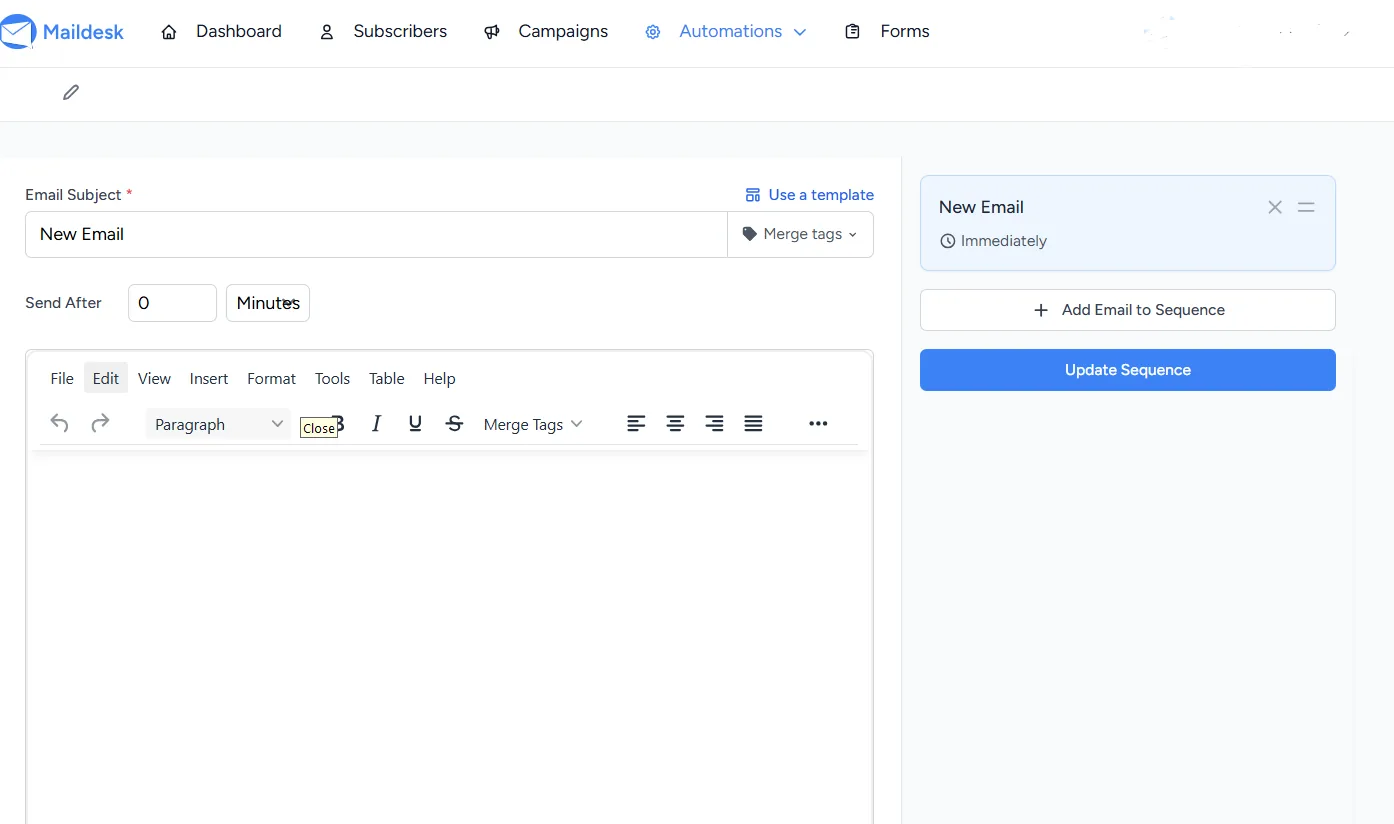
Email automation is typically available through email service providers and marketing platforms. But not every platform is built with your business in mind.
Maildesk is built specifically for solo coaches, consultants, and course creators. It gives you easy-to-use automation and segmentation tools to nurture and follow up with prospects — without spending hours learning complicated software, and without advanced technical skills.
The goal is simple: help you get more value from the discovery calls you’re already generating. Because you shouldn’t have to choose between following up with prospects and doing the work your clients are already paying you for.
Stop Chasing More Leads. Start Converting the Ones You Have.
Your discovery calls may not be failing because your offer is bad. Your leads may not be the problem either. And you may not need more traffic.
You may simply have a gap between interest and decision. And that’s where follow-up matters. Every prospect who leaves a discovery call without a structured follow-up is a potential client who could slip through the cracks.
So before you spend more money getting people into your funnel, take a look at what happens after they enter it:
- Are you following up consistently?
- Are you addressing their objections?
- Are you continuing to build trust?
- Are you giving them useful reasons to stay engaged?
- Are you making it easy for them to say yes?
Because sometimes, the next client you need isn’t another lead.
It’s the one you haven’t followed up with yet.
Start following up effectively and converting the leads already in your list with Maildesk. Start your free trial.
← Back to blog