By Ozioma Onwumah · Content Marketer at Maildesk ·
From Leads to Clients: The Complete Client Acquisition System for Coaches and Consultants
More marketing won't fix an inconsistent pipeline. The six-stage system that turns attention into clients — and how to find the stage where yours is leaking.

Why did you become a coach or consultant?
For many, the answer connects to a need to impact other people’s lives. That’s the rewarding part — and it can quickly become frustrating when finding clients proves difficult.
You wake up each day ready to change the world, but finding a client who actually needs and will pay for your services forces you to question whether you’re doing something wrong. So you decide to do more marketing, or reach out to more people. The results don’t change much.
You’re left wondering why you can’t seem to bring in more clients.
This article explores why you may not be attracting new clients, and what you can do to fix it.
Why Can’t You Find Clients?
According to research from the International Coaching Federation, the number of coaching practitioners reached 122,927 in 2025, while industry revenue increased significantly. The same research found that coaches anticipated generating more revenue by increasing the number of coaching sessions rather than simply charging higher prices.
So if more people are entering the industry and coaches expect demand to keep growing, why does finding the next client still feel so difficult?
The answer may lie in how you’re acquiring clients.
You can have great service, valuable content, a professional website, and impressive expertise — and still struggle to maintain a consistent flow of clients if there’s no process connecting all of it.
Think about it this way: attracting someone’s attention is only the beginning. You still need to give them a reason to stay connected, build enough trust for them to consider working with you, and make it easy to take the next step.
That is what client acquisition is designed to do.
What Is Client Acquisition?
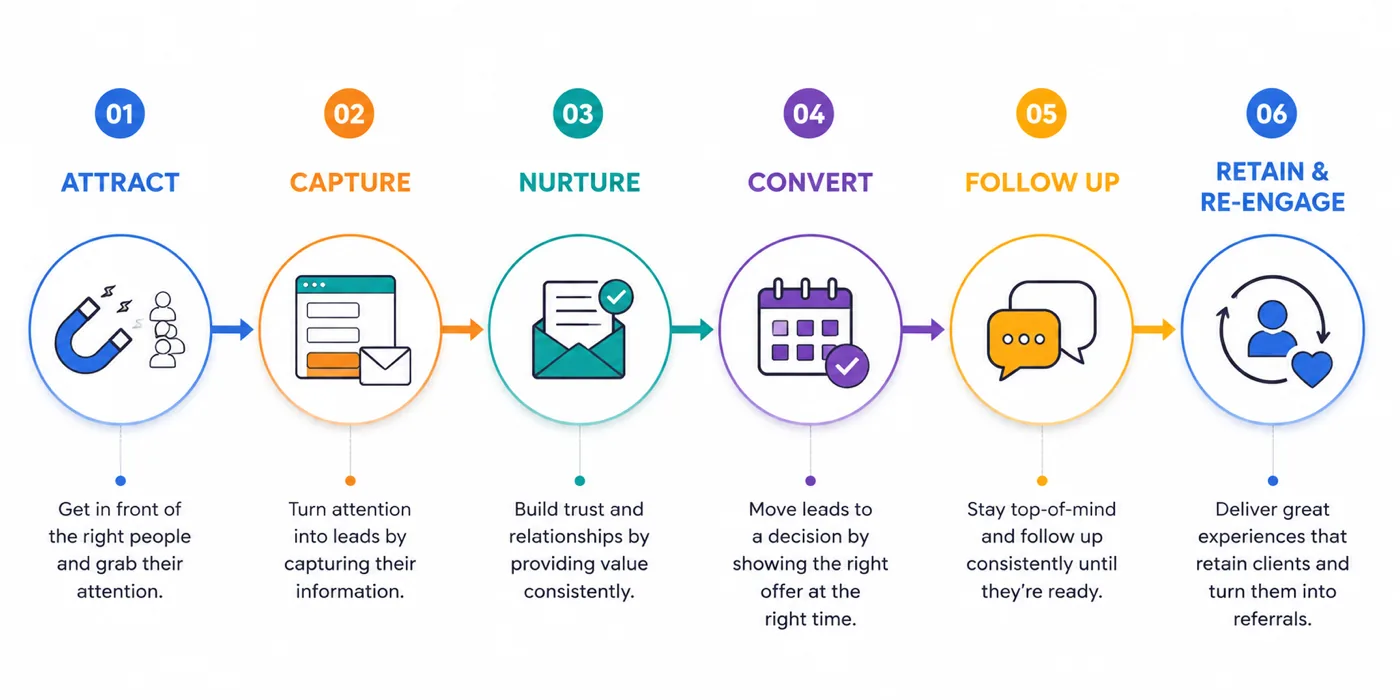
A client acquisition system is the process you use to find, attract, nurture, and convert potential clients into paying clients. Put simply, it’s the journey a prospect takes from the moment they discover your brand to the moment they decide to work with you.
This means client acquisition goes beyond posting on social media, creating a lead magnet, attending networking events, or reaching out to potential clients. Those activities bring people into your world, but they don’t automatically turn those people into clients.
The real question is: what happens after someone discovers you?
An effective client acquisition system moves a prospect through six connected stages:
Attract → Capture → Nurture → Convert → Follow Up → Retain & Re-engage
You may already be doing some of these things. You may even be doing all of them. But having the individual pieces isn’t enough — they need to work together as a system.
And if you’re struggling to acquire clients consistently, there’s a good chance one or more parts of that system isn’t working as well as it could be.
Why Do Coaches and Consultants Struggle to Get Consistent Clients?
Having a framework is one thing. Being able to execute it consistently is another.
You may have a website, social media presence, lead magnet, email list, and discovery call process — yet still struggle to turn your marketing efforts into paying clients. Here are the most common reasons.
1. Your positioning is not clear

Photo by Sable Flow on Unsplash
You can’t consistently attract the right audience if they don’t understand who you help, what problem you solve, and what outcome you can help them achieve.
Many coaches struggle with niching because they worry that choosing a specific audience will reduce their potential clients. So instead of speaking directly to one group, they create content that tries to appeal to everyone who could possibly benefit.
It sounds like a good way to increase reach. In reality, it makes your message harder to understand.
When your messaging tries to speak to everyone, a prospect may see your content and think: “This sounds useful, but is it actually for someone like me?”
Your positioning should make that answer obvious. A potential client should quickly understand who you help, what problem you help them solve, and what transformation they can expect. Because if the right people don’t recognise themselves in your message, they’re less likely to take the next step.
2. You’re waiting until you need clients before marketing
The numbers on referrals are striking. Consulting Success found that more than half of consultants get 60% of their business from referrals, and a 2026 Careertrainer report puts referrals at 60–70% of new business for established coaches.
There’s no denying referrals matter. But here’s the problem: what happens when they stop?
Many coaches only start marketing when they need a new client. While they’re fully booked, marketing takes a back seat — they stop creating content, engaging their audience, nurturing prospects, and building authority. Then a client finishes their programme, a space opens up, and suddenly they need someone to fill it.
So they start posting again. They reach out. They rebuild momentum. Then a referral comes in, they get busy, marketing stops — and the cycle repeats.
This creates an unpredictable pipeline where periods of being fully booked are followed by periods of scrambling. Your marketing shouldn’t only happen when your calendar is empty. Keep building relationships and creating demand while you’re busy, so that when capacity opens up, you aren’t starting from zero.
3. You’re relying on content without a conversion path
Some coaches are genuinely consistent with marketing. They post regularly, share valuable insights, discuss their audience’s problems, and establish themselves as knowledgeable professionals.
But there’s still a problem: they treat getting attention as the same thing as generating clients.
It isn’t. Your content can generate thousands of impressions and still produce very few clients if there’s no clear path for interested people to take the next step. Someone can read your LinkedIn post today, find it useful, and completely forget about you tomorrow.
That’s why your content needs to do more than generate likes. It should give the right people a way to continue the relationship — download a relevant resource, join your email list, attend a webinar, book a discovery call.
The goal isn’t to turn every post into a sales pitch. It’s to make sure that when someone is interested, there’s somewhere for that interest to go.
4. You’re attracting attention but not capturing leads

Photo by Austin Distel on Unsplash
Maybe your LinkedIn posts get 1,000+ impressions. Maybe you have hundreds of connections and more than 1,000 followers. But you’re still struggling to get clients.
The problem may not be that you’re not attracting attention. It may be that you’re not doing enough with the attention you already have.
Someone can discover your content today and become interested in your expertise. But unless you give them a way to stay connected, that relationship can end as quickly as it started.
This is why capturing leads matters. Your audience should not exist only on a social platform you don’t control — you need a way to keep communicating with people who’ve shown genuine interest. That’s where lead magnets, newsletters, webinars, assessments, free training, and discovery calls become valuable.
The goal isn’t simply to collect email addresses. It’s to create a bridge between “I’ve discovered you” and “I’m ready to work with you.”
5. You’re generating leads but not nurturing them
Say you’ve fixed the previous problem. People are downloading your resources, joining your list, attending your webinars, booking calls. But you’re still not turning enough of them into clients. Why?
Because getting someone into your funnel is only the beginning.
You can’t collect leads and then send the same generic offer every few weeks hoping someone eventually buys. Your prospects are at different points in their buying journey:
- Some need more education.
- Some need more proof.
- Some need to understand the problem better.
- Some understand the problem but aren’t convinced your solution is right.
- Some just need more time.
That’s where lead nurturing comes in. It lets you continue the conversation after the initial interaction — educating prospects, demonstrating expertise, sharing case studies, addressing objections, and helping them understand the value of solving the problem.
And this is where email becomes particularly useful. Instead of relying on a prospect to remember to come back to you, you have a direct channel to keep providing value.
6. You’re getting discovery calls but losing prospects afterwards

Photo by Vitaly Gariev on Unsplash
What happens after someone books a discovery call with you? If you’ve been treating the call as the finish line, that could be part of the problem.
A discovery call doesn’t guarantee you’ll land the client. It’s an opportunity to understand the prospect’s situation, determine whether you can help, and move the conversation toward a working relationship. But the conversation doesn’t end when the call does.
A prospect might be interested but need time to think. They might have an unresolved objection. They might need to discuss the investment with someone else, or simply need more confidence before deciding.
If you don’t follow up, you leave the next step entirely to them — and sometimes even an interested prospect won’t come back on their own.
We’ve explored this in more detail in Why Your Discovery Calls Aren’t Converting Into Clients.
7. You’re doing everything manually

Photo by Brands&People on Unsplash
You can have the right positioning, create content consistently, capture leads, nurture them, run discovery calls, and follow up. But if you have to remember every single step yourself, your system gets harder to manage as your business grows.
With one prospect, remembering what happened feels easy. With ten or twenty, it’s a different story:
- Who had a discovery call?
- Who needs a proposal?
- Who said “I’ll think about it”?
- Who needs an objection handled?
- Who isn’t ready yet?
- Who should receive a case study?
- Who needs to be re-engaged?
At some point, tracking all of this manually becomes difficult. And when something gets forgotten, a potential client falls through the cracks.
This is where having a system becomes essential.
What Should Your Client Acquisition Funnel Look Like?
Now that we’ve looked at why your efforts may not be producing consistent results, let’s look at what a functioning system actually looks like.
Your client acquisition system doesn’t need to be complicated. It needs to be connected.
Attract → Capture → Nurture → Convert → Follow Up → Retain & Re-engage
Step 1: Attract the right audience
First impressions matter. The attraction stage is where your ideal client first encounters your business — through LinkedIn, Facebook, Instagram, X, search engines, partnerships, webinars, or referrals.
But don’t make the mistake of thinking more traffic automatically means more clients. Traffic isn’t the goal. The right traffic is.
Your marketing should make it clear who you help and what problem you solve, so the right people recognise that your expertise is relevant to them.
Step 2: Capture their interest
Once you’ve attracted the right people, you need a way to keep the relationship going. You give an interested prospect a reason to take the next step, and a way for you to keep communicating with them.
Depending on your business model, that could be a lead magnet, newsletter, webinar, assessment, free training, or discovery call. The specific mechanism matters less than the purpose: turning temporary attention into an ongoing relationship.
Someone who gives you permission to keep communicating is very different from someone who simply scrolled past your post.
Step 3: Nurture the relationship
This is where you help your prospect move from interest toward readiness, and email plays an important role because it gives you a direct way to continue the conversation.
You might begin by welcoming a new subscriber and delivering the resource they requested. From there: educate them about the problem, share useful insights, demonstrate expertise through case studies, address common objections, and introduce your offer when it’s relevant.
The goal isn’t to send as many emails as possible. It’s to give the prospect the information and confidence they need to decide.
Step 4: Convert interest into action
At some point, your prospect needs a clear opportunity to take the next step — booking a discovery call, applying for your programme, scheduling a consultation, or purchasing directly.
The conversion stage is where your marketing and nurturing lead somewhere tangible. Don’t make an interested prospect figure out what they’re supposed to do next.
Step 5: Follow up
Not every prospect becomes a client immediately. Some need more time. Others have questions or objections. Some simply get distracted by everything else happening in their lives and businesses.
That doesn’t necessarily mean they’re no longer interested.
Follow-up lets you continue the conversation without putting unnecessary pressure on the prospect. After a discovery call you might recap what you discussed, provide a relevant resource, share a case study, address an objection, or simply reopen the conversation. The key is to follow up with a purpose.
Step 6: Retain and re-engage
Client acquisition shouldn’t end the moment someone becomes a client. The people you’ve already worked with can become repeat clients, referral sources, or advocates.
Depending on your offer, this could involve onboarding, check-ins, renewals, upsells, referral requests, or re-engagement campaigns for older leads and past clients.
The point is simple: don’t constantly start from zero. You’ve already invested time building these relationships.
How Do You Build a Client Acquisition Strategy That Works?
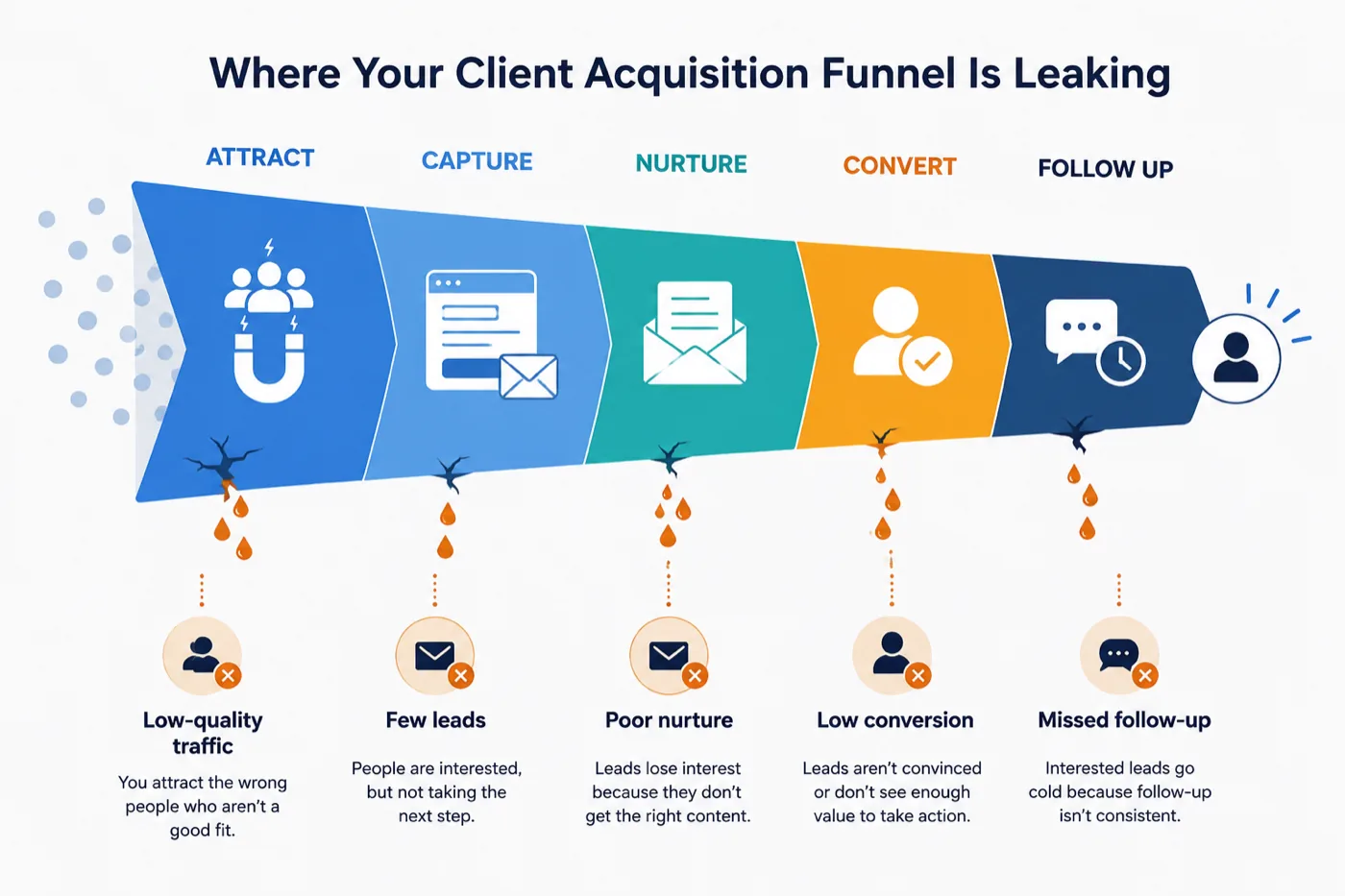
You don’t need to build a complicated marketing machine overnight. Start with the fundamentals and build from there.
Step 1: Define your ideal client
Before you decide where to market or what content to create, get clear on who you’re trying to reach:
- What problem are they dealing with?
- What have they already tried?
- What outcome do they want?
- What would make them recognise they need your help?
The clearer you are, the easier it becomes to create marketing that speaks directly to them.
Step 2: Create an offer around a specific problem
Your offer should be easy to understand. Compare:
Vague: “I help businesses grow.”
Specific: “I help B2B consultants build predictable client acquisition systems without relying entirely on referrals.”
The second tells the prospect who the service is for, what problem it addresses, and what outcome to expect. Your prospects shouldn’t have to work hard to understand why your offer is relevant to them.
Step 3: Choose two or three marketing channels
You don’t need to be everywhere. Trying to maintain a presence on every platform spreads your time too thin, particularly if you’re running your business yourself.
Identify the channels where your ideal clients actually spend time and focus there. The important thing isn’t choosing a channel — it’s creating a connected journey between the channel, your lead capture, your nurturing process, and your offer.
Step 4: Create a lead capture mechanism
Once you’re attracting the right audience, give interested people a way to stay connected: a checklist, template, assessment, mini-course, webinar, guide, or free training.
Your lead magnet doesn’t need to be complicated. It needs to be useful enough that the right prospect thinks, “This is exactly what I need.”
Step 5: Build an email nurture sequence
This is where lead capture begins to turn into a relationship.
A simple sequence could start with a welcome email and the resource they requested. From there: address the problem they’re experiencing, teach something useful, demonstrate your approach through a case study, handle a common objection, and eventually introduce your offer.
There’s no single sequence every coach should use. The important thing is that your emails have a purpose and move the prospect forward rather than repeatedly asking them to buy.
Step 6: Create a discovery-call follow-up system
Your follow-up shouldn’t depend on whether you remember to send an email three days later. Create a process for what happens after each call:
- A prospect ready to move forward needs a proposal and a clear next step.
- Someone who says “I need to think about it” needs more information, proof, or time.
- Someone who isn’t ready at all is better suited to a longer-term nurture sequence.
The point is to stop treating every prospect the same. Your follow-up should reflect where that person is in their journey.
Step 7: Automate what doesn’t need to be manual
Once you know what should happen at each stage, automation helps you execute consistently — welcome emails, lead nurturing, discovery call follow-up, segmentation, re-engagement, reminders, and sequences based on prospect behaviour.
Automation doesn’t mean you stop being personal. It means you stop relying on your memory to maintain every relationship.
What Should Coaches and Consultants Automate?
You don’t need to automate every interaction. Some conversations should stay personal. But plenty of repetitive processes don’t need to be handled manually:
- Before a discovery call — confirmation emails, reminders, pre-call education, and what to expect.
- After a discovery call — call recap, relevant resources, case studies, objection-handling emails, and re-engagement based on the prospect’s situation.
- For prospects who aren’t ready — ongoing educational content and resources, without having to remember to contact each person individually.
- Once someone becomes a client — onboarding, welcome emails, check-ins, referral requests, and renewal or upsell opportunities.
The goal isn’t to automate the relationship. It’s to automate the parts of the relationship that don’t need you.
How Do You Know Where Your Funnel Is Leaking?
Sometimes the easiest way to improve your system is to stop looking at it as one big problem, and look at each stage instead:
- Plenty of views, very few leads → your positioning, call-to-action, or lead-capture mechanism needs attention.
- Lots of leads, very few discovery calls → look at your nurturing process, offer, or the transition from lead to sales conversation.
- Plenty of discovery calls, very few clients → examine your sales process, offer, trust-building, and follow-up.
- Interested on the call, then they disappear → your follow-up deserves attention.
- Constantly chasing prospects and forgetting conversations → you don’t have a system managing the journey.
The important thing is not to immediately assume you need more leads. Find the leak first.
Why Does Email Marketing Matter for Coaches and Consultants?
Social media helps people discover you. Email helps you stay connected to them.
That distinction matters because your prospects may not be ready to buy the first time they encounter your brand. They may need time to understand their problem, learn about your approach, see evidence you can help, compare options, justify the investment, or simply become ready to act.
You can’t control exactly when that happens. But you can control whether you remain part of the conversation.
Instead of hoping a prospect sees your next social post, you can deliver useful information directly to their inbox. And with segmentation and automation, you can make that communication relevant to each prospect’s stage — especially useful when you’re a solo coach without a sales team following up for you.
How Maildesk Helps You Turn Leads Into Clients
You don’t need another complicated marketing tool. You need a system that helps you manage the relationships you’re already building.
Maildesk is built specifically for solo coaches, consultants, and course creators who want to get more value from the leads they’re already generating. You can capture new prospects, segment them by interest or action, nurture them with relevant content, and follow up after discovery calls — then automate those processes so the right prospect receives the right message without you managing every interaction manually.
The goal isn’t to replace the personal relationship you have with your prospects. It’s to make sure that relationship doesn’t get forgotten simply because you’re busy serving your clients.
And because you’re already running a business, you shouldn’t have to spend hours learning complicated software just to stay in touch with people interested in working with you.
You Don’t Need to Do More Marketing. You Need a Better System.
If you’re struggling to find clients consistently, the answer isn’t always more content, more followers, more platforms, or more leads. Sometimes you already have enough attention — you just aren’t doing enough with it.
Your marketing gets people into your world. Your client acquisition system gives them a reason to stay.
Attract → Capture → Nurture → Convert → Follow Up → Retain & Re-engage
You attract the right people, give them a way to stay connected, and build trust while demonstrating your expertise. You make it easy to take the next step. You continue the conversation even when they aren’t ready immediately. And once they become clients, you keep building the relationship.
So before you decide you need more leads, take a closer look at the ones you already have:
- Are you attracting the right people?
- Are you giving them a way to stay connected?
- Are you nurturing them?
- Are you following up after discovery calls?
- Are you keeping track of prospects who aren’t ready yet?
- And do you have a system that makes all of this possible without requiring you to remember everything yourself?
Because you don’t need to spend all your time chasing your next client. You need a system that helps the right clients find you, trust you, and stay connected until they’re ready to work with you.
Ready to build that system? Start your free Maildesk trial.
← Back to blog